


All Posts in art

- No Comments!

Please Wipe Your Shoes Before Walking on Michelle Alexander

Michelle Alexander on Reclaiming the Body Through Art 

Michelle Alexander, Split Self, 2021, digital image on paper

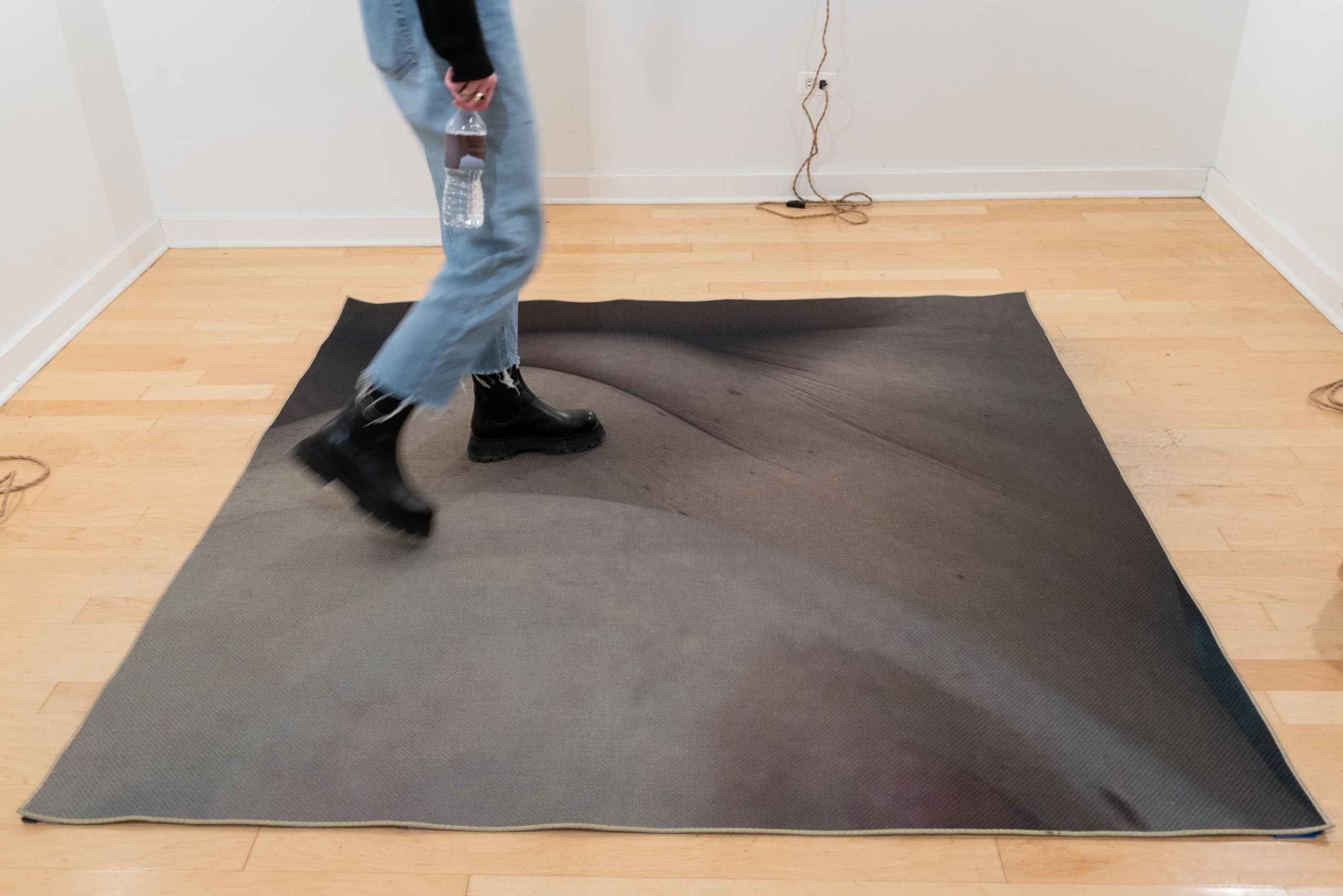
Chicago-based artist Michelle Alexander is not afraid to make you uncomfortable—especially if you’re standing on her nipple. In this conversation, Alexander and I discuss everything from her recent exhibition My Body/Your Object, which featured carpet-sized images of her skin that viewers could walk on, to how her fashion background helped shape her craft now. Whether talking about curating shows or the highly personal works of Félix González-Torres, Alexander’s interest in the body—as something consumable, shared between people, soft yet unruly—leaks into every word. There's no shortage of artists' work about the body, but, given that our animal selves are the source of all experience, the body—as Alexander proves—will never be dull material.

— Mieke Marple

Mieke Marple: In your most recent exhibition My Body/Your Object at Mathew Heberlein Contemporary, you printed out oversized close-ups of your body that visitors could walk on. These close-ups feature skin folds, cropped nipples, and freckles. What was your intention here?

Michelle Alexander: I was trying to create a physical confrontation between the viewer and my body, but not in a voyeuristic way. These images are intimate but not flattering. They’re cropped, zoomed in, and raw. I wanted to remove the typical cues we use to categorize bodies, especially female bodies, and instead show skin as terrain, as surface. Letting people walk on these images raised questions for me about ownership, consumption, power, and awareness. It was less about making a statement and more about offering a moment of discomfort or pause.

Michelle Alexander, Grounding Touch, 2021, digital image on paper and lino print on mylar

MM: Did the way visitors interact with the works surprise you? Were there any differences between what you expected and what actually happened?

MA: Definitely. Some people walked right across the carpets without a second thought. Others hesitated and walked around, or asked if it was okay. That hesitation said a lot to me. Watching people decide how to move through the space revealed something I didn’t fully anticipate: my own dynamic with people-pleasing. It made me wonder if putting myself literally on the floor to be walked on was a way of reclaiming that tendency, of setting new terms for how my body is engaged with. The work became a kind of boundary-setting exercise, even as it appeared boundary-less.

I was also hyper-aware of if and when people even realized they were interacting with the works; drinking it, eating it, holding it, stepping on it. That blur between art and environment was intentional, but it also left me wondering: When does the work become more about them than me? Or is that transfer even possible? I don’t think I have a clear answer yet, but that tension between control and release, between author and audience, has stayed with me.

Michelle Alexander, "My Body/Your Object," 2025, installation view at Mathew Heberlein Contemporary, Chicago IL. Photo credit: Jonas Muller-Ahlheim

MM: I see echoes of Eleanor Antin’s “carving piece” and Marina Abramović's “Rhythm 0” in this piece. What is the artistic legacy that you see yourself a part of?

MA: Wow, that is so flattering to be talked about in conversation with those incredible artists and those works that feel both surreal and deeply meaningful. I definitely look to artists who use their bodies as material, especially women who use their bodies as a canvas in ways that are surprising, uncomfortable, and complicated. That legacy matters to me not in terms of notoriety or performance, but in how those artists create space for bodies that don’t behave or perform in socially acceptable ways. My work is part of that lineage, but it’s also grounded in installation and material manipulation. I’m interested in what the body leaves behind: impressions, fragments, traces. It’s less about performing the body in real time and more about making its presence felt after the fact, what lingers, what’s carried, what’s been touched, changed, or awakened inside you.

MM: You worked as an associate designer at Amur, assistant designer at ML Monique Lhuillier, and an assistant designer at Longstreet, developing garment designs for brands like US Polo Association, Limited Too, Kensie Girl, New Balance Girls, and Nine Threads. How does your background in fashion inform your art practice? Were you always making art or is artmaking something you came to later?

MA: Art and creative expression have always been central to my life. Before studying fashion, I studied painting and photography in undergrad. Making art has always been my best outlet for trying to understand myself and the world around me.

Fashion came later and became my first real education in how bodies are controlled. I learned how silhouettes can be shaped, how garments can seduce or restrict. That had a huge impact on how I think about form. In my artwork now, I still use fabric, structure, and decoration, but I twist them. I make them heavy, raw, awkward, and vulnerable. My relationship to fashion and my body is complicated, and that complexity drives a lot of my practice.

The pressure to be thin, beautiful, put together, or perfect trickles into every part of the fashion machine. That pressure is palpable, and it stays with you. It gets under your skin, into your daily habits, and shapes your sense of self-worth.

While I was always creative, I didn’t come into art seriously until later. It became a way to process everything left behind in me. Through my work, I’m often trying to reclaim the body, to disrupt those systems of control, and to ask new questions about how we define beauty, power, and presence.

portrait of Michelle Alexander

MM: You also recently curated a show “Connective Thread” at Ivory Gate Gallery that included work by Michelle Grabner, Adrianne Rubenstein, and yourself, among others. What made you want to curate this show, and how do you see curating as an extension of your practice?

MA: That show came out of admiration and creating opportunity, honestly. I was a fan of these artists first. I reached out to people I deeply respect, and I was lucky they trusted me enough to say yes. The show was rooted in my own questions about womanhood, softness, and strength. I was looking for work that engaged with the body not just as subject, but as material, as something to be shaped, tested, and transformed.

Curating gave me the chance to create a space where different forms of embodiment could be in conversation. It felt like assembling a shared nervous system. The decisions I made were intuitive and personal, completely tied to my own practice. It didn’t feel like a separate role; it felt like an extension of the same questions I ask in my studio.

So much of the time, how and where artists show their work is taken out of our hands. Curating felt like a way to reclaim some of that. To mold the vision, shape the atmosphere, and build a context with intention and make it happen. It gave me the opportunity to expose myself and others to artists I admire and to bring that admiration into a public, collective space.

MM: What are you working on now? And where do you see your work going in the next five years?

MA: I’m working on some new sculptural installation pieces that explore how the body responds to external pressure, especially within male-dominated spaces. I’m experimenting with fragmented forms and possibly integrating sound elements to deepen the physical and emotional impact. I’m still really interested in how environments can hold the weight of a body or push against it and how materials can carry emotional residue.

A lot of my focus continues to be on the complications of being in a body, trying to understand it, and building spaces where viewers can see themselves and feel seen. I want the work to create moments of confrontation but also recognition, especially around the layered and often contradictory experience of being in a female body.

Looking ahead, I hope to push further into immersive installation and maybe start working in more public or site-responsive contexts. I want to continue using materiality to shift emotional landscapes, not just visual ones.

In five years, I hope I’m still making work that is honest, uncomfortable, and generous in its tension, work that opens space for softness, contradiction, and deeper understanding of embodiment, especially within the ongoing messiness of just being.

Michelle Alexander, Flayed, 2022, digital images on organza, charcoal, pins, dressforms

MM: If you could ask a question to any artist, living or dead, who would you choose and what would your question be?

MA: I’d like to talk to Félix González-Torres. I’d ask him how it feels to see people interact with “Untitled” (Portrait of Ross in L.A.), to watch them take candy, eat it, and walk away. How does it feel to see something so heavy handled through sweetness? What does it mean to make grief consumable, to represent a body as a pile of shimmering candy? I’d want to know what candy meant to him in that context, what the sugar, the metallic foil, the act of giving away and disappearing stood for emotionally, politically, personally.

I’d also ask about the role of the viewer, how it feels to have them physically participate in the piece, to complete it, even when they might not fully understand what it’s about. When the work is so deeply personal, how does it feel to have that meaning fragmented by the public? Does it matter if they don’t know the story? Or is that distance part of it, too? I think his ability to hold intimacy and anonymity in the same gesture is incredibly powerful, and I wonder how he carried that tension as an artist and as a person.

To learn more about Michelle, follow her Instagram and visit her website.

Michelle Alexander, Weight of the Ideal, 2024, mixed media

Michelle Alexander, The Pressure, 2025, installation view at Ivory Gate Gallery, Chicago IL.

Michelle Alexander, Pieced Back Together, 2021, mixed media

For more from Mieke:
Miekemarple.com
Instagram
Substack
- No Comments!

Surviving the Dream with FIDLAR

by Grady Olson

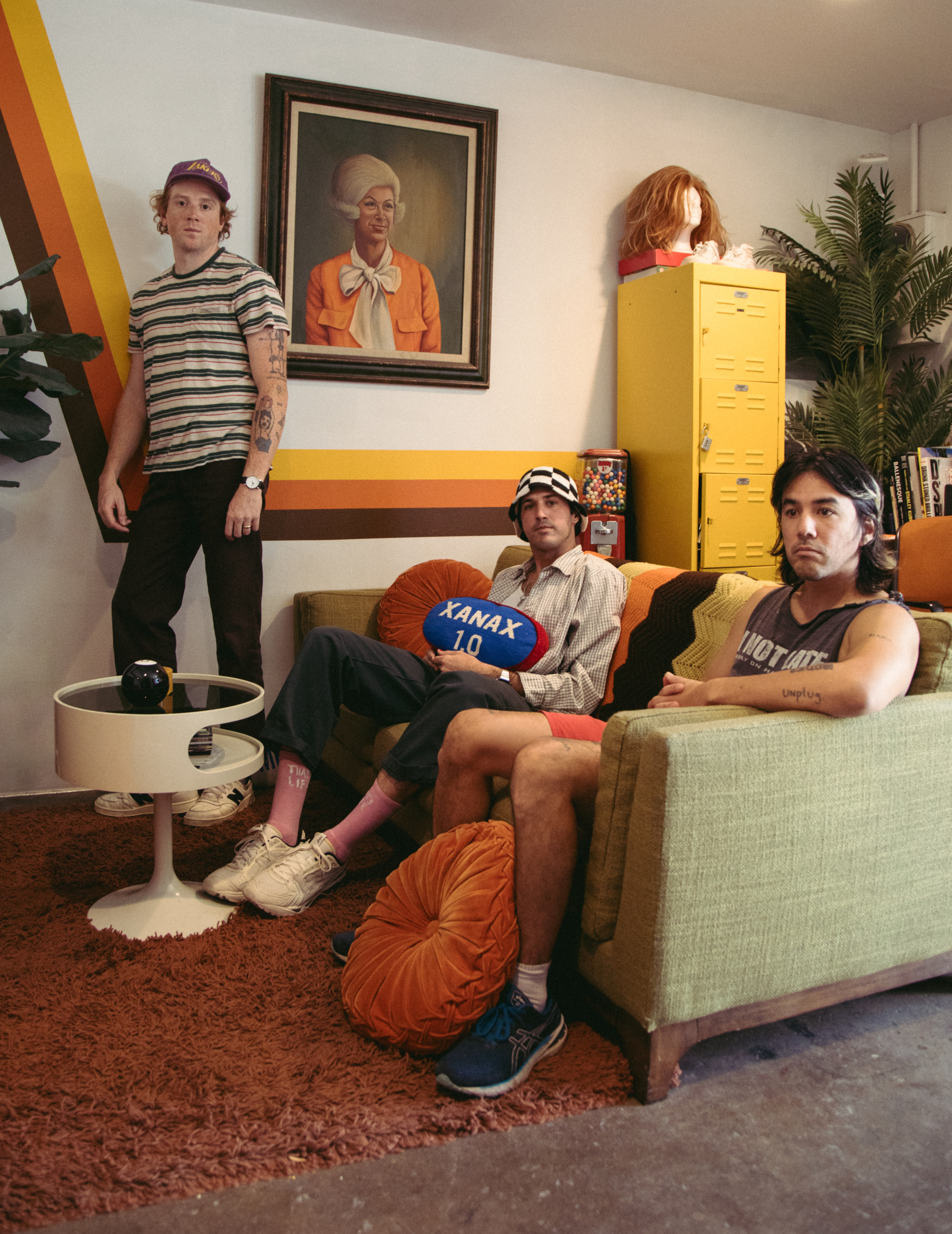
Photo by Jordan Cramer

In the heart of East Los Angeles, tucked away in the Balboa Recording Studio and art space, FIDLAR – Zac Carper, Max Kuehn, and Brandon Schwartzel – crafted Surviving the Dream, their first album in over five years. Recorded in 12 days, with just the help of a few buddies. That’s how Zac Carper, Max Kuehn, and Brandon Schwartzel wanted to do it. But also kind of how they had to do it, with no label, no fancy producer, a testament to FIDLAR's DIY ethos. But who gives a shit where you record, the boys are back and they’re the same as they ever were but a lot different. 

Photo by Jordan Cramer

The Dream Evolves

Surviving the Dream is a phrase they coined based on Aussie band and good friends Dune Rats' motto, "Living the Dream." But for FIDLAR, the dream has shifted and evolved into a new meaning; it now teases on that darkness that is a constant underlying positivity, reflecting the realities of getting older and navigating life's ups and downs. As lead singer Zac Carper explains, "They used to be crashing on couches and people would ask how they were and they'd just say, 'living the dream.' So whenever I’d be out during covid and someone would ask me how I was doing, I’d say, 'surviving the dream.'"

Photo by Jordan Cramer

Creative Process in the Midst of Chaos

For Carper, the new album's creation was intertwined with his journey of self-discovery as it’s the first album since the frontman was diagnosed with bipolar disorder. Having a somewhat better understanding of his creative process now, which comes in waves while in a manic state, "It took longer. I was scared to drop in." he admits, describing the waves of manic creativity that fuel his songwriting. "Once I do, there's no stopping that wave. It’s like meth. I’m up for three days. I’ve tried meds and they make me okay but it kind of fucks with everything else. So I’ve just got to find that right cocktail.” 

Photo by Jordan Cramer

It's in the aftermath of these manic episodes that the editing and refining process takes place that shapes FIDLAR's distinctive sound. “I do drafts. I’m a big fan of drafts. It starts out with a ukulele and then there will be like 7 demos to it. So once I create, I just create and create and then crash. Then I’ll listen back, like okay; what sounds good? There's a lot of editing.”


"Once I do, there's no stopping that wave. It’s like meth. I’m up for three days."


DIY or Die

With no label backing, FIDLAR welcomed back their familiar DIY approach to recording. "No one would give us a bunch of money," Max Kuehn quips. "No one would do it for us, we’re off a label, so why not just self produce it," adds Brandon Schwartzel. This self-reliance allowed the band to maintain creative control and capture the raw energy that defines their live performances. 

Photo by Jordan Cramer

The same goes for the album cover. Wanting to create that paint pen, exacto knife, ‘broke kid let’s just make something aesthetic,’ they just did what they wanted with the font and the smiley face. “We took that and manipulated it to use as a single art piece but then also throughout the lyrical videos. We scanned it and fucked it up, paint penned it, scanned it again.” Brandon

Photo by Jordan Cramer

Aging Gracefully in the Mosh Pit

While the band members may be getting older, their fan base seems to stay young, which is good for the guys  "After the pandemic, we realized everyone is like 15. What the fuck happened?" Carper laughs. “We were all expecting everyone to have kids and pull their Fidlar shirt out of the garage, like an old dude with a beard and a beer. But then there was this youthful sort of energy that really pumped us up.”

Photo by Jordan Cramer

For FIDLAR, energy is the driving force behind their music. "One of the main rules is just energy, energy, energy. How do we bring the most energy to it?" Carper emphasizes. This focus on capturing the live essence of their music allowed them to record the album quickly and efficiently, prioritizing feeling and vibe over technical perfection.

This youthful energy has injected new life into the band, like a punk fine wine, they’re aging gracefully in the mosh pit, inspiring them to continue pushing boundaries and creating music that resonates with the young and restless. 

Photo by Jordan Cramer

The Dream Continues

FIDLAR's longevity can be attributed to their unwavering commitment to craft and DIY spirit. As Schwartzel puts it, "Let’s get it out, go play, and then keep going. Keep playing, keep writing, and then record stuff when it comes." Surviving the Dream is a testament to this enduring passion. FIDLAR is here to stay, ready to ride the waves of music, life, or whatever else for years to come. 

Photo by Jordan Cramer

Photo by Jordan Cramer


FIDLAR - 2024 NORTH AMERICAN HEADLINING TOUR DATES

September 23 - Santa Cruz, CA @ The Catalyst

September 24 - Sacramento, CA @ Ace of Spades

September 25 – San Francisco, CA @ The Regency Ballroom

September 27 – Portland, OR @ Roseland Theater

September 28 – Seattle, WA @ Neptune Theatre           

September 30 – Salt Lake City, UT @ The Grand At The Complex

October 1 – Denver, CO @ Summit

October 2 - Fort Collins, CO @ Aggie Theatre

October 4 – Minneapolis, MN @ Varsity Theater

October 5 – Chicago, IL @ Vic Theatre

October 7 – Toronto, ON @ Phoenix Concert Theatre

October 8 – Buffalo, NY @ Electric City

October 9 – Brooklyn, NY @ Brooklyn Steel

October 11 - Philadelphia, PA @ Theatre of Living Arts

October 12 – Boston, MA @ House of Blues

October 14 – Washington, DC @ 9:30 Club

October 15 – Asheville, NC @ The Orange Peel

October 16 – Nashville, TN @ The Basement East

October 18 – Carrboro, NC @ Cat's Cradle

October 19 – Atlanta, GA @ Variety Playhouse

October 21 – Dallas, TX @ Granada Theater

October 22 – Austin, TX @The Mohawk

October 25 – Tucson, AZ @ Hotel Congress Plaza

October 27 - Del Mar, CA @ The Sound At Del Mar                       

October 31 - Los Angeles, CA @ The Bellwether

February 17-25, 2025 - Flogging Molly’s Salty Dog Cruise

- No Comments!

AK the Savior and Sagun on Bridging the Gap

Throughout time, humans have used dissent to bring ourselves closer despite our differences. By understanding and finding out we have more in common than we think, a beautiful thing called culture arises. Culture is the nexus of certain communities that are striving for something bigger than themselves. It isn't something that should be tainted by a selfish need for preservation, but something to be shared with the world. Because of that, for better or for worse, society has evolved thanks to culture.


AKTHESAVIOR and Sagun photographed by Rosie Matheson


Arts, fashion, and politics deviate from the classification of race and finances because there's an intrinsic yearning for unity. In that regard, it's quite superficial to use one's culture as a guideline for one's personality. That's how arguments about co-opting and a lack of respect for purity are in our day-to-day feeds. This observation becomes more accurate in modern times, where everyone wants to make a statement but isn't saying anything at all. Presently, we can communicate with whoever and whenever, however, we still feel alone.

Despite that, AK the Savior, a New York-born and now Los Angeles-based rapper and Nepal-based lo-fi producer Sagun, pulls you a seat at their table in their recent album titled "U R Not Alone." On this album, the duo navigates through musical genres while rapping about topics involving cultural politics and discovering where you belong, no matter where you're from. Comparable to the opposite ends they came from to create this album, the two also have a mutual understanding and respect for one another that is non-sequitur to music. They are building a model of self-confidence and staying true to what they believe in because culturally, that's what people want to be a part of.


AKTHESAVIOR and Sagun photographed by Jordan Smith

1. Do you think someone’s appearance is as important as their actual skill set when it comes to music?

Sagun: Personally, it does not matter, but like you said, it does play a big factor these days. But at the same time, if the music is good, no matter how good you look or dress, people will love you no matter what.

Ak: I agree with Sagun too. I think it's important, but not as important as it once was. It was way more important back in the day to look the part and to be a superstar. But nowadays some people are just super talented; uploading their videos or music where it speaks for itself in a sense.

2. One is from Nepal and one is from New York. How'd you guys meet and how'd this project come about?

AK: Sa, you want to tell him?

Sagun: Yeah, so I always wanted to make this kind of rap album, and I was talking to my manager about it to search for a rapper who could collaborate with me. My manager came up with the idea of having AK on this album and told me to send him beats and just see what happens. I just sent him beats one by one and it started from there through email.

AK: I just finished dropping an album called "Almost Home" and I was still in the zone creating music. I'm hands-on with my shit. After that, COVID hit and nothing was popping, but I love music, so I continued pursuing it through it. I dropped an album even though there weren't going to be any tours and I checked my email to see who's hitting me up. I kept networking, and Sagun's manager hit me up with this proposal about a lo-fi producer that would be a good match for me. He then sent me beat after beat and once I got the beats, I heard them and then instantly wrote the beats. It was an instant connection through Zoom calls and getting to know each other. Sagun then came to America for the first time; we met in person and that's when we started working on shit.

3. Do you think the most radical thing nowadays is just to be normal?

AK: Yeah. I agree with that. In today's world, music matters, but it's more about content. It's king right now. People are focused on ways to go viral. Within the fashion world, to go viral is to have shock value, so people might buy certain things that they may not necessarily like the Mario boots. They'll just wear that shit to go viral, but not like it.

Sagun: I agree. Some people just do anything and everything to go viral. I'm not mad at that though.

AK: Yeah, fuck it.

4. Talking about anime has been sort of taboo for minorities to talk about in recent years. Do you like that this conversation is more on the forefront or does it feel like just another opportunity to exploit another subculture?

AK: I think anime is for the world. Just because someone doesn't bring anime into the forefront of a conversation doesn't mean they're not about anime. I think what people are worried about now is that anime is getting super popular. It's becoming larger and larger and when things get big, more people just jump on the trend to be cool. Anime people are real gatekeepers and if someone's repping something that they know wasn't in it in the first place. Then it becomes "Nigga, you never liked that kind of shit before...". I think you just couldn't tell someone was into anime based on their music and image. You don't have to promote something to like it.

Sagun: Everyone around used to watch it, so I could never think or see people say they don't like anime.

AK: For instance, I always said I loved anime and made references in my music, but I feel like if those same people saw me out in New York with my homies looking like goons; they would think there's no way this guy watches anime. I got many anime tattoos and they're part of my life because they changed my life, so you can't judge someone based on how they look.

5. I know of the recent loss of the creator of Dragon Ball Z, Akira Toriyama. How did you feel about the sudden loss and how did his work influence you as an artist?

Ak: That shit fucked me up. Dragon Ball Z changed my entire life. As I grew up on it, I realized there were a lot of subliminal messages within the show. Some people may just see it as a cartoon, but Ki is a real thing. It's not just energy blasts and shit. Ki is the real energy we all have. Akira took that concept and made it playful, but we all have energy within us.

Sagun: I feel the same when I watch the Vineland Saga. It teaches you how to control yourself, your people, and the environment around you. You guys should check it out. I love that one.

AK: In the anime, there are so many gems that are dropping that apply to real-life men. People sleep on it! I encourage anyone reading this to watch anime because it'll change your life. And if you don't like fighting or energy balls and shit, watch Death Note (laughs). That's a great warm-up.


AKTHESAVIOR and Sagun photographed by Brayton Bowers


AKTHESAVIOR and Sagun photographed by Rosie Matheson


6. I know fashion and music go hand in hand, but it can sometimes be an obviously desperate opportunity for an artist to capitalize on it as a "business venture". What other ventures do you think we need more of from our current and future artists?

AK: For me, I'm one of those artists who are already venturing into different things. I'm into fashion, so that's not farfetched as something I could get into. I have friends in the fashion world too and I see how hard that shit is. It's some shit that's easy to tap into unless you're the type of artist who'll drop anything and people are going to follow it. I don't think I would get into it like that, but I don't want to cap myself either.

IR: You're also an actual artist.

AK: Yeah, so a couple of business ventures that I do include a jewelry company called "Florescent Treasures" and I even wrote my own manga called Nakaomiru, which means look inside. I also do paintings now and then because I'm the type of person who, whatever resonates with me at the moment; I'm going to tap into.

Sagun: I'm getting more into videography and photographing. I like how videos are done and if I'm not into that, I would get into coding. I love coding.

7. How much does your art correlate to your music, and vice versa?

AK: After I linked up with Sagun after recording "You Are Not Alone" almost 2 and a half years ago. I started painting a lot during our time recording it. I wanted to make new shit and thought, "How do I make this shit correlate to my music?" because niggas is not going to just accept a painting, so I had to make it make sense. All the cover art and single art was me painting. I had a project called "Tracing Patterns" where I wanted to connect my paintings with my music. I wanted to make something for what it is and I hope people don't get too judgmental about it.


8. Given your start in the rap group Underachievers and being part of this psychedelic rap that rappers such as the Flatbush Zombies, Asap Rocky, Danny Brown, and yourselves brought to the generation. Do you think drugs were the bigger inspiration or what role did psychedelic drugs play in this exploration for you?

AK: I think psychedelics played a huge role like you said, and people were connected to us through psychedelics. But I feel like I was speaking on more experiences I had when I was younger. The Underachievers were taking psychedelics when we were younger when we created "Indigoism" and things like that, but people got the misconception that we were tripping every single day. We weren't tripping every single day. Four times a year I would trip, but I can only speak for myself. Now I only take psychedelics once or twice a year when I need that spiritual push or boost of inspiration. Psychedelics is something you shouldn't abuse because if you do, that's how you lose yourself.

IR: I mean, that's how people become Deadheads into their 70's.

AK: Yeah(laughs). There's nothing wrong with being a fan and taking psychedelics. But if you let that shit just take over your life, you remove the balance and become lost. I love psychedelics because they changed my life, but you don't need them. I think I never needed it. It's here on earth for us to use and work together, but you don't need that for the spiritual growth that I've gotten. You just need to work to be the best version of yourself by reading books and enhancing your knowledge to bring enlightenment to your life. Drugs don't enlighten your life. That doesn't work and it doesn't fix your problems. It's just you and the journey you choose to go on.


AKTHESAVIOR and Sagun photographed by Brayten Bowers


AKTHESAVIOR and Sagun photographed by Rosie Matheson


9. You come from a multicultural background, which is one of the themes of your upcoming project. You are not alone. Growing up, did you feel out of place as someone who's multicultural and what helped you feel more included?

Sagun: I would never be who I am if I didn't grow up in my environment, so no. I never felt that I was in the wrong place or at the wrong time. That's totally who I am and I've always accepted it.

AK: I feel you 100 percent. I'm thankful to be from the Caribbean Islands and get the influences from the music to the food. It makes us who we are. When I was a kid, I went to school in Harlem from elementary to junior high school, bro. At that time, growing up, Spanish and black people were being. Oh, my god. As a kid, I was like, Why, and kids would try to fight me? It was just so weird because even other black people were fucking with me because they thought I was Spanish.

IR: Given how you look, I was going to say that! Was it a Dominican trying to fight you even though you guys are the same color? (laughs)

AK: BROOOOOO!!! I always questioned it. Why, why, why? Then I went to school from Manhattan to Brooklyn as I got older with more black people and Caribbean culture. In Harlem, niggas used to make fun of me and shit. Saying, "You got big ass lips, bro!". They said mad funny shit that made me feel like I'm not shit. But when I got to Brooklyn, I was the most popular dude in the school. I was just confused during that time, but all that shit happened for a reason and I'm grateful for it.


10. How do you think racial and cultural issues will change in the future as society continues to blend?

AK: I have high hopes for the future. The issue we have today is that the people who created these ways of thinking and ways of life through racism, etc. are still in power. If they're not directly connected to it, their sons and daughters are now in power. As we grow older and new generations come, there's going to be an understanding that we're all together as a human race. This skin color sh*t is stupid now.

Sagun: Totally.

AK: They've even shown now on certain websites what the future people are going to look like if we blend.

IR: Yeah, everyone's going to look like The Rock.

AK and Sagun: (laughs).

AK: I don't want everyone to look the same. That's boring, but if we all look the same, how are you going to judge me? Like on this album, "You Are Not Alone" ,we want you to feel like we're different from you. We are all humans with similar and different experiences, but the bottom line is that this is life. These are things that we go through and we're just sharing life as you are too.


AKTHESAVIOR and Sagun photographed by Rosie Matheson

11. What would you say to someone dealing with these types of issues when trying to find their voice?

AK: Follow your heart and whatever resonates with you. Do what matters and if you feel a certain way, express yourself. Don't bottle it up. When someone says no one understands me, it's like, of course, no one understands you because you didn't express yourself. If no one is truly listening; go out and find the person who's going to listen. You are not alone.

Sagun: If you think you're going to fail, keep trying.