
All Posts in Events

- No Comments!

Ten Years of Grøss… Wow, Forreal?

First things first:

  1. 10YR RSVP
  2. NEW MERCH
  3. APROPOS SCULPTURE

In 2016, we started making a magazine in San Francisco without particularly knowing what a magazine was supposed to become. There was no grand "ten-year plan." Mostly, there were artists we liked, things we wanted to make, places we wanted to go, and a recurring willingness to make goofy shit happen because why not?

Apparently that can add up to a decade, hah!

So we’re bringing Grøss back to San Francisco for ten days to celebrate the whole strange thing: 67+ print features, hundreds of artists, stacks of paper, parties, exhibitions, stickers, questionable decisions, and a few objects that have somehow survived it.

Some of those objects aged better than others.

We recently dug up an old piece of Grøss merch from roughly the beginning of the magazine. Ten years of washing, wearing, folding, losing, and finding had slowly destroyed the logo. The print had cracked. Edges softened. Letters broke apart.

Technically, it was deteriorating.

It also looked fucking great. Like a real testament to time well spent.

Rather than restore it or only focus on the new and shiny, we used the damage as the reference for a new collection.

The new Grøss merch takes that accidental ten-year-old graphic and pushes it forward: a logo designed not from a pristine vector file buried on an old hard drive, but from the physical evidence of somebody actually living in the thing.

An archive created by wear.

Which, strangely, brings us to the magazines.

Apropos

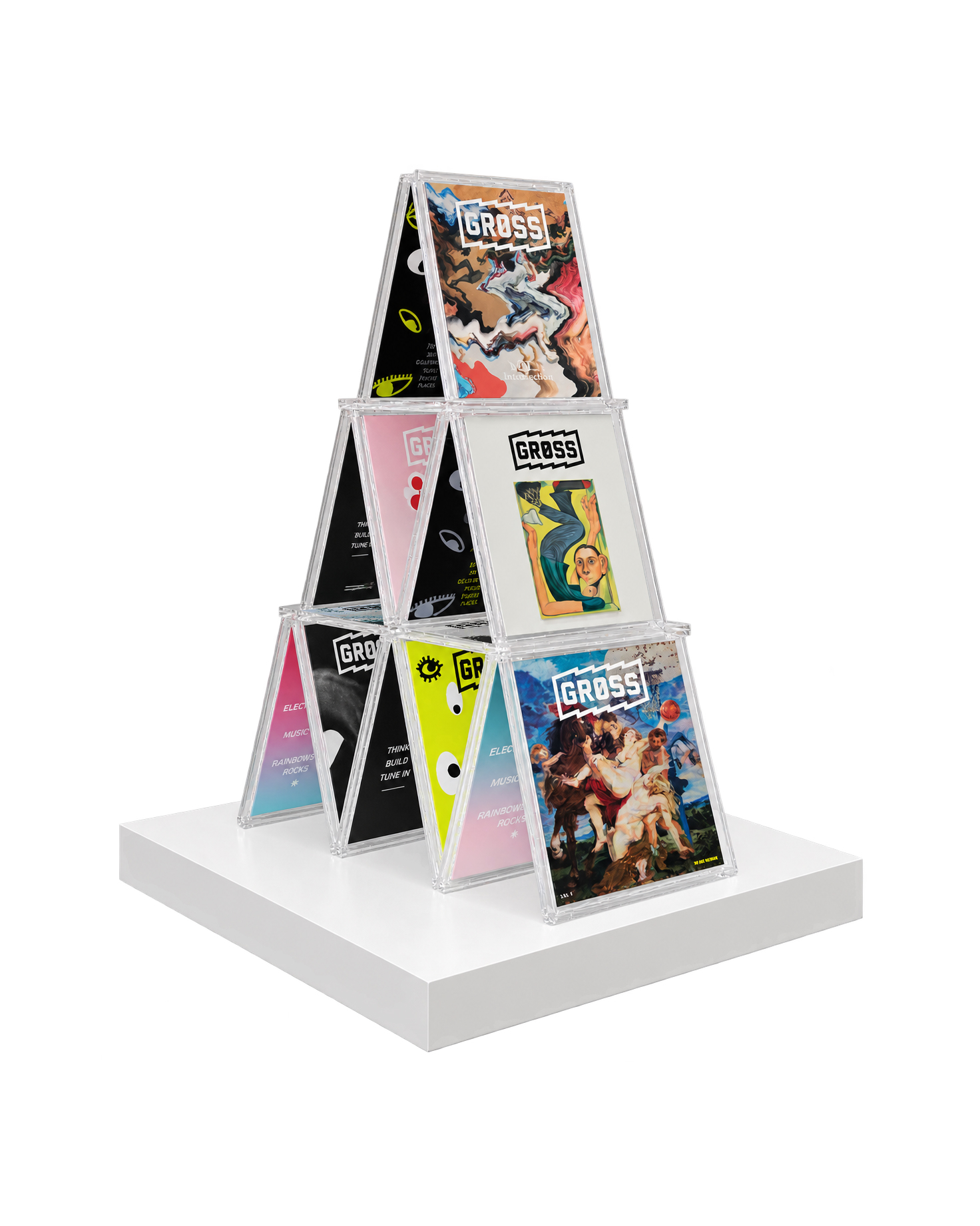
In 1990, the year I was born, Maurizio Cattelan made 'Strategies,' a precarious house of cards constructed from Flash Art magazines, aluminum and glue. To me, that work represents the art world's fickle ecosystem: artists, galleries, critics, publications and markets leaning against one another, somehow keeping the whole thing upright.

I first encountered 'Strategies' at MAMbo in Bologna in 2021. It stuck with me, and I knew I wanted to reinterpret it using copies of Grøss eventually. It just needed a reason.

Ten years of Grøss feels like reason enough.

Cattelan transformed a publication into an artwork. For a decade, Grøss has done something like the inverse: transforming artworks, artists and the strange ecosystem surrounding them into a publication. Now the publication becomes artwork again. A neat feedback loop of appropriation.

One very important structural difference, though:

Cattelan's aluminum supports attempt to disappear, creating the illusion that his magazines are performing an improbable balancing act. Here, there is nothing to hide. Each Grøss is individually preserved inside a crystal-clear acrylic case—part frame, part exoskeleton, part preservation cryochamber. The support structure is clean, rigid, and proud to be seen.

The magazines don't bend. They're not cut, glued, or sacrificed at the altar of art. They're protected as the artifacts they've become after ten years of making the damn things.

An appropriator appropriating an appropriator and calling it 'Apropos.' 🙂

Whether this is homage, theft, institutional critique, publishing therapy, or an unnecessarily elaborate way of displaying magazines is up to you.

Maurizio, if this somehow finds its way to you: I owe you one.

Literally. I'll send you an edition. All I need is an address.

The Archive Is Open

For the anniversary pop-up, we’re also doing something we rarely get to do properly: putting the entire decade in the same room.

Visitors will be able to look back through 67+ Grøss print features spanning the magazine’s history.

Not a greatest-hits edit. The actual trail.

Different artists. Different eras. Different design decisions. Different versions of us figuring out what the publication could be.

We’ll also be making framed prints of featured title spreads available, so you can take a piece of the archive home.

There will be original artwork throughout the space, limited-edition sculptures, the new merch collection, live music, DJ sets, and whatever else inevitably happens once enough people are standing in the same room.

Come get wild with us.

Ten Years. Ten Days.

There is one slightly stupid part about spending ten years making something and then building an anniversary exhibition around it:

We’re only keeping it open for ten days.

Then it’s gone, gone, gone.

Which is probably appropriate.

Grøss has never been particularly interested in pretending things last forever. Shirts deteriorate. Exhibitions close. Stickers end up on bathroom walls only to be scraped into the trash. People move. Cities fluctuate. Artists become famous or disappear or make something completely different.

Sometimes preservation matters.

Sometimes deterioration makes the thing better.

Mostly, it's important to make the damn thing while you can.

So, San Francisco:

Come celebrate ten years of Grøss with us. Look through the archive. See Apropos in person. Buy a shirt based on a shirt that barely survived. Take home some art. Hear some music. Stay too late.

RSVP or purchase any merch, and you’ll also receive a limited-edition Grøss sticker.

Ten years down.

Still making goofy shit happen.

Because why not?

— Victor Gonzalez
Co-founder, Grøss Magazine
- No Comments!

Heritage, Curated by Ethereal Reflections in Portland, OR

Maynard Villaflores/BFA.com + Nicholas Wilson

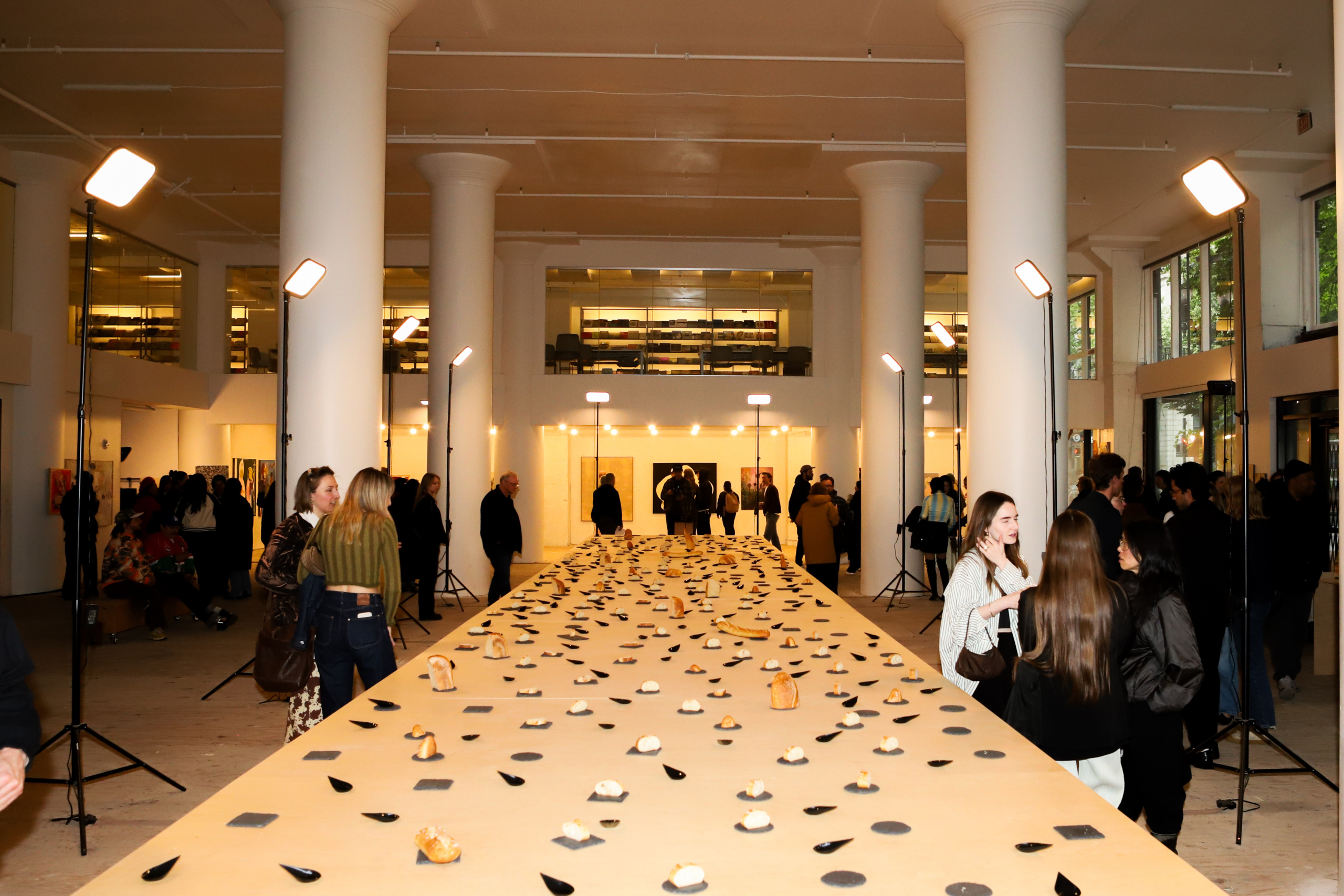
On May 15th, Design Portland hosted Heritage, the eighth exhibition curated by Lena Vasilenko and Emma Strgar of Ethereal Reflections. For just one fleeting night, 33 artists working across painting, sculpture, ceramics, and photography came together to unpack the strange, layered weight of inheritance — not just culturally, but emotionally, socially, and personally too. Heady stuff for dreamy people.

Maynard Villaflores/BFA.com + Nicholas Wilson

The show circled around questions that don’t really have straight answers: What do we inherit versus invent for ourselves? How much of identity is chosen, and how much is assigned? What gets lost when labels are assigned? Is that good or bad?

What's cool, though, Heritage didn’t approach these ideas in some strict academic way. The exhibition felt human and messy in the right places. It felt personal without becoming overly precious.

What made the show memorable was its balance. Thirty-three artists is enough to easily lose sight of a common thread, but the curation didn't meander. The exhibition presented more like an ongoing conversation — different voices bouncing off each other without needing total agreement. Some of those voices were soft and subtle while others we're boiseterous. All were heard.

There was also a clever edible installation woven into the evening, which somehow made perfect sense. Taste and memory are known to be closely related anyway. Certain flavors can pull you backward through time faster than photographs can. It added yet another layer to the experience without screaming for attention.

Maynard Villaflores/BFA.com + Nicholas Wilson

More than anything, Heritage felt refreshingly sincere and welcoming. At a moment when a lot of contemporary art seems trapped between branding exercises and social performance, this show chose reflection instead. Quietly. Confidently.

Somewhere between the sculptures, photographs, and conversations drifting through the room, the exhibition landed on a truth most people already know deep down: we’re all carrying things that were handed to us. The real question is what we decide to keep and why???

Photo: Maynard Villaflores/BFA.com + Nicholas Wilson

- No Comments!

Beers, Paper, and Legacy: Tom Marioni and the SIA in San Francisco

This story begins with beer. Or rather, it always began with beer if you were hanging around Tom Marioni’s studio in San Francisco any time after the 1970s. The man once declared, with deadpan conviction, that "drinking beer with friends is the highest form of art." And you know what? We're inclined to believe him.

Drinking Beer with Friends, 1970, Museum of Conceptual Art (MOCA)

Tom Marioni is a conceptual artist and a quietly towering figure in West Coast art history — a sort of artistic monk crossed with a social sculptor, operating on his own wavelength while inadvertently building one of the most enduring scenes in contemporary conceptual practice. Founder of the Museum of Conceptual Art (MOCA SF) in 1970, Marioni turned his weekly studio gatherings into living artworks: beer (and martinis), conversation, and performance as medium. It wasn’t about spectacle. It was about showing up. If you know, you know — an inner circle kind of thing.

That’s what makes the latest exhibition at GCS Agency so surprisingly significant. Society of Independent Artists: Works on Paper feels almost too chill to carry the kind of historical gravitas it does, and yet, here we are. This is an homage to a 55-year lineage of anti-institutional creativity that ultimately managed to smash right into the institutions anyway.

Installation of Beer with Friends at The Hammer Museum, 2013

The show is anchored by Marioni as the leader, but he's far from the only heavy-hitter in the room. A third of the 36+ participating artists have works in the permanent collections of institutions like MoMA, SFMOMA, the Getty, and the Smithsonian. Yeah, this is a low-key salon-style group show. Kind of nutty. And yes, you’ll be standing in front of works by people who have and continue to define what contemporary American art even is.

Tom Marioni in his studio. Photo by Sonja Och for The Chronicle

Let’s name drop a bit, because why not? (It’s fun) There’s Susan Middleton, whose haunting portraits of endangered species live in the Smithsonian and have graced the pages of National Geographic. It’s giving raw childhood wonder and amazement. There’s Robert Bechtle, one of the acclaimed godfathers of Photorealism, with paintings that depict calm suburban scenes as mythical, powerful moments. Bechtle’s works are now held by 18 global museums, including The Whitney, The Met, MoMA, SFMOMA, The Guggenheim, and The National Gallery, among others. Eleanor Coppola (yes, that Coppola) has her own body of collage and visual work that supplements a life of storytelling already cemented in American film history. Also, Roman Coppola (Eleanor’s son) has works included making this a family affair.

Paul Kos (b. 1942) Alkali Flats, 1974 Black and white photograph, unique 14½ x 21½ in.

Enter big boss Paul Kos, whose video and installation work (uhhh Sound of Ice Melting… !!) practically wrote the West Coast conceptualist playbook.. His poetic handling of silence, time, and sensory space does not scream for attention, but it’s hard to forget once you experience it. Then there’s John Held Jr., mail art’s archivist-in-chief, who turned his obsessive commitment to ephemera into one of the most important documentations of a movement that refused to be pinned down.

The rest of the artist lineup is no filler either. No fluff here, folks. Organized by Alberto Cuadros, a longtime attendee of Marioni’s Wednesday gatherings (and now a card-carrying SIA member himself), the show is a testament to the intergenerational reach of this community. It’s a very special exchange of experience. Artists range from Bay Area educators to international exhibitors, from seasoned sculptors to photographers, painters, and the rare type of person who still sends actual mail with art inside.

Alberto Cuadros, SIA member and organizer of this exhibition

And what ties it all together? Paper. Humble, analog, unassuming paper. Works include drawing, collage, print, and conceptual notation. Some are crisp and beautiful; others are strange and coded; a few look like they could disintegrate if you breathe too hard. But they all feel alive—they all feel like part of something bigger than any one moment or trend.

In a time when everything is optimized, digitized, and built for metrics, Works on Paper feels like a beautiful glitch in the system. It’s art for the sake of making, thinking, riffing, and remembering. There’s no algorithmic urgency here, no branded content loop. Just a bunch of relentless artists, who could justifiably be resting on their laurels, deciding to show up for something loose, collaborative, and real.

So sure, show up for the Marioni of it all. But stay for the Pacificos, the funky drawings, the quiet power of a legacy that doesn’t need to shout to make its point. This is San Francisco art history in its least filtered form.

Opening June 18, 5–8pm @ 201 Jackson St., San Francisco

RSVP here. Be there.

Just don’t forget the password: social sculpture.