Jasaya Neale: Definitely because you'll see these fashion model dudes that kind of do art, but they get known for modeling more rather than being taken seriously as artists. That's for anything too. Like, you could be a musician and kind of stop doing music and start doing fashion or stuff like that. I think it's just so natural when a brand works with you and likes your work. I feel like I've been blessed enough to do my own thing. With modeling and with artwork, you can do stuff with the biggest brands. I can see how that kind of popularity can erase the work that you've made, but it's all still me. Because sometimes you can benefit from brands like they are from you. We make the shit look cooler, so at the end of the day, if you keep that mindset, it'll always stay. Manifest, work on the shit you like, and it'll work out.
IR: Like some of the art legends, such as Basquiat, Jackson Pollock, and Picasso, they all had great personal style. How would you describe yours?
JN: Personal style, man... that's a good question because it does come back to the artist and their style and who they are. It's as important as the work. Much like how you look and how you carry yourself. Your energy, you know. I'll speak the word before anything. I think my first start just goes back to skating. I grew up skateboarding and being in that culture. There was that freedom of wearing whatever the fuck you wanted to wear. I never really felt for trends, and people looked at me weirdly, just growing up as a black skater. I mean, this is every black skater's story, but my personal style came from that. There was such a group of people skating, and back then, you were influenced by the baggy stuff, Nike SBs, and stuff like that. That was just always what I used to wear, but then I started getting into film, cinema, and photography. The old vintage look and 60s style, really. Tailoring incorporated how I put all my stuff together. Now today, I feel like cinema and jazz are a big influence on my style. I'm a moody type, so I love jazz. (Laughs)
IR: It's funny because when I first saw you at Capri Club with your people. I was like, man, this really is the "Mr. and Mrs. Cool guy bar," in a genuine way.
JN: Man! Shout-outs to Capri! Capri has the best people compared to other bars in LA. To me, Capri is just a good spot to meet good and genuine creative types. Artsy and stylish. It's always been cool.
IR: I think it's because it's the closest thing to a niche European bar that has gathered these like-minded people. Speaking of, when I saw you at Capri that night, I was like "Dude...this guy looks like the man"(Laughs). But I noticed one thing that really stood out, the KC Royals Hat you were wearing...
So when my boy Steve was asking if you were from Texas, I thought that was sick because you wore it as a symbol of pride, but also humbling nobility.
JN: Yeah! I wear all these like nice clothes, but let's not forget, I'm still from Kansas City. This is what made me, right? That's exactly what it is, man. People who can come from these small towns and shit that move to New York or LA and start wearing Yankee hats like I'm this now. They forget where the hell they came from. Come on. That's not what it is. I'm very humbled by what I've done. There's so much more to do, but I know I've made it far in my career to realize where I've come from, and I don't want to forget that. I'm doing these campaigns, shoots, and galleries, but you've got to let people know where you're from. You know what I'm saying? You're not going to catch me with Dodgers on my head. I'm not from LA, but I love LA. I respect it. I'm grateful, but also with my style, it's more of a uniform, which is very important to me. I feel like having a uniform, you know, is not for clout, but separating yourself from other people, because it's great to stand out. I think having a solid uniform and the consistency of having one is very sick in my opinion.
IR: Who are some artists who have inspired your personal style?
JN: Crazy. I mean, as far as OG artists...Noah Davis is a really big inspiration as far as artwork. A lot of African American cinematic shots that he would paint, but as far as the people that I'm really inspired by are the homies here, man. Like, shout out to Devin Reynolds, Ozzy, and Mario.
IR: Do you know Michael McGregor?
JN: Yeah, Gregor. Shout out, McGregor. I wouldn't be where I am in the art industry if I didn't meet these dudes. I would get put in group shows years ago from them, just like knowing me and being like, "Tree, like, you want to get in this group show I got?" That opened up gallery opportunities by going to their group shows, where people would be like, "Who's this cat?" I've gotten solos just from going through Ozzy shows. He and some other homies were getting known off that as well. That's the importance of having a good community here, too. These artists that I like looked up and pushed me to get to where these cats are. The homies.
IR: Is there a big art scene in Kansas City?
JN: KC has a big art scene for us. School-wise, KCAI is one of the best art schools in the country. KC Arts, too. It's right next to the Nelson A. Museum, but as far as like how we do art in LA, I feel like you don't really have to go to art school out here to get a solo show. I didn't go to art school. Almost did, but then I would go to these things downtown called First Fridays. It's where you just kind of like set up a booth or table and sell things. A lot of people come out, and I would sell drawings. I was like 17 or 18, and the moment that I knew I didn't want to go to school for art was when a woman who couldn't speak English bought my drawings. I think she was Brazilian. Anyway, I was selling those drawings for $100 at the time, and she grabbed 4. Again, she didn't speak any English, but something moved her to buy it and that's when I knew I needed to do this shit. From there, I was doing work for commissions, taking requests from people, but more amateur stuff. I mean, over time, you move to different cities, you get exposed, you meet people, and you grow. Moving out here and obviously getting into those group shows by meeting people helped me learn more about the art world. These experiences alone helped me realize that I made the right choice.
IR: Do you think being a Black artist is limiting or has a negative connotation when defined as one?
JN: That's funny you said that. I was just talking to a friend about this the other day. To answer that, I never wanted to be in that. That category of Black art. African American artists who only worked with Black galleries, black fundraisers, and things like that. I think it's very cool, though. From where we came as Black people, to be able to have our own galleries. You know, it's a lot of wealthy black people that are supporting Black artists and putting them in museums, which is fire, but I never wanted to be limited. I never wanted to just have to work with Black this and Black that, so that's why I'm in different shows that are group or topic-based. I've done an Afro-Caribbean show just out of love and curiosity, besides being that. My pops was from Trinidad, and being Trinidadian as well as Cuban, I always felt something shared between those cultures. Being out here with a lot of Hispanics and my homies put on a lot of Hispanic shows, where they put their people on the map in art. That made me think that I don't see any Caribbean shows here in LA seen as high art. That's something I wanted to do for sure. I used to paint old Latino people here in LA, to now working with European brands, but the message remains. I just don't want to limit myself because that's not the whole world. In America at least, Black art always had a traumatic aspect to it. That's the shit that irks me. I don't have to make art with colorful depictions of slavery because I feel that's the only way rich white people are going to collect it out of guilt. Some love the sob story of the African Americans’ work, but what I'm saying is that it doesn't necessarily have to be the main thing you do as a Black artist. I will say, I have respect for those artists who have made a full career out of it, but I would never limit myself in that way. I always wanted to be seen as a fine artist who can work with any culture. I want to show in galleries in Japan because they really respect art, regardless of whether it's only Black art. It's only art, period.

IR: How has fashion and modeling redirected the way you paint?
JN: Not in a crazy impactful way, but I think just more as it influences in the same way as a person who's never traveled and then seen the world, and how it opens up your eyes to meet different people. Style and how everyone else influences you is the same way as listening to different music. Just that one song or artist can open you up to new genres. Talking to models and producers on set, seeing what they do for a living, compared to what I do for a living. It's a nice wake-up call that I take back with me when I get home, so I can see how I can put this in my work.
IR: There's a great use of hue coordination in your paintings that allows the colors to be the real luxury in your work. Are you a fan of Kerry James Marshall?
JN: Yeah, he's one of my favorites.
IR: Do you know that whole thing about him using over 50 different shades of black in his paintings?
JN: Yeah, that's the detail of look. I have a book upstairs called The Studio Artist's Life, which has a whole bio on all his shades of black. It's insane. I kind of changed the different saturations that I used in my work. I used to do a lot of dark. Well, I still kind of do dark and moody colors, but when I do more of the luxury or loose works, I try to do brighter colors. Like if I'm painting ties, socks, and t-shirts, I just try to incorporate how I would like to dress into the work, too. I kind of use those colors depending on the work that I'm in.
IR: Your art details a life of luxury. From cars to clothes, do you think that it is still relevant in life to strive for nowadays?
JN: Yeah, I think it's definitely coming. We've seen it the most in the last few years. These couple of years have been very important. It's been very preppy and dapper, and that's been coming out in these little groups that are in style nowadays. It's very important right now. Younger people are realizing that having a genuine style now can be profitable.
IR: You know what's ill? I just got back from a trip to Rhode Island. Newport, to be specific, was the epitome of generational wealth. I was just surrounded by 4th vacation homes, boats, and people fueled by brunch chardonnays without a care in the world. It was actually sick (laughs). You'd be lying if you didn't want that lifestyle.
JN: (Laughs) A lot of those cats out there on the East Coast really embrace the lavishness of old money. I know brands like Gant and Drake's Diary do the most pop-ups in Rhode Island. They have a huge fan base out there. I can see that, and that would be sick to experience that at one's point. (Laughs)
IR: What's the most valuable possession you own?
JN: Probably my rings, my ties, and my loafers. Most importantly, the rings, though. I incorporate them into a lot of my work, too. A lot of hands and gold, which has always been a very Caribbean-Trini thing. I've always been connected, just like luxury gold rings, and if I don't have them on, I feel naked. It's always been a part of me, you know? It's going back to tone. Black skin and gold. I feel like darker skin has always been more attracted to gold. My mom was a jewelry designer, so I literally grew up around it. She would set up in venues and sell her jewelry. Though I'm the only artist/painter in my family, I've always been around people who were creative.

IR: Did you ever help contribute to her designs or jewelry-making?
JN: For sure. All of us did. I have five brothers and three sisters. A big household where she would always have us help her take her trays out to the venue she was doing, or help get her pliers to make jewelry. She would make her rings all the time. So yeah, I've always had rings on. I was the only one who really wore rings among my siblings. I don't paint when my rings are on, but like as soon as I'm done, I get them back on and keep it moving.
IR: What's something Kansas City has given you that you always take with you anywhere you go?
JN: Man... That's a good question. Obviously, the hat is the one. I think of how we met. Kansas City is a very, very friendly Midwest city with cheap beers, barbecues, and sports. The key is friendly beers while bringing you a good time, but humanizing people has always been a really important thing that I've done since I lived out here. Naturally, meeting people and just being genuine or not putting on an act gets you something in the future. I mean, that could be over-said also, but that's the Midwest. You think about the Midwest, and if you were to meet someone else from KC, St.Louis, or Chicago, you instantly have a connection. I take that everywhere I go, and that's why I wear the KC hat. It's funny in relation to LA because you always get that thing about transplants, but in my experience, I've noticed there are certain cities where people come from where they’re the same living in LA. Maybe there's something in the water in the Midwest. I think it's just that working-class, boots-on-the-ground kind of attitude. We're working together, and all that other shit is extra. I'm just here to do my job, do my thing, and just keep it moving. Sometimes I think that I'm not supposed to be here, especially since where I grew up. I grew up in the ghetto hoods of Kansas City with five brothers, a single mom, and no dad. I never even met my Pops. In high school, I knew a lot of kids I grew up with who got killed, and when skateboarding came along, that was obviously an outlet that helped me stay out of trouble. Those experiences alone made me grateful for my life and understanding that you can still love a place even if you have to leave it for good. I always keep that with me.
IR: Should fashion be held in the same reverence artistically as art?
JN: 100%. Speaking of that, I don't design clothes, but when I was growing up, I would go to a tailor and get clothes cropped. I think getting into that when I was in high school and going to prom, it always made me more interested in suits. I wanted to tailor my suit back when my shit was mad baggy. That shit was in, and I wanted to figure out how to do it. I bought this vintage ‘60s Playboy suit from this vintage shop back in high school, and I learned how to sew through YouTube tutorials. I learned how to do it, tailored my prom suit, and everything. From that moment, I realized how hard, how much time, and how many measurements when trying it on. That was a lesson in patience. I think if I were to transition into that, which last year I did a pop-up where I did 10 hand-painted T-shirts. Some white T-shirts and black T-shirts with jazz album cover illustrations. I did it in the most natural way possible I could do it. That transition really showed me to respect the seamstresses, the tailors, and the people working in these industries. Yeah, eventually, who knows, man... Like if a brand hits me about it. For sure. I got fingers crossed.
IR: What is something you would like to leave behind?
JN: That's a good one....Something to leave behind. I never really thought about that...I think my rings, my art, and the things that influenced me. I don't want to necessarily be this deeply impactful or influential artist, but I do want to be the example of what you can be if you believe in yourself. Just work fucking hard and do what you want to do. If you want to be an artist, you just have to not work a 9-5, and if you have to, that's sick too, but just know that being an artist is a full-time job. That's the only way you're going to make it happen. I learned that working at a job where I can't go to the studio, or I'm left too tired to create after, is detrimental. In the end, I just want to inspire people to go for it, and if I have some kids... leave them behind with my rings. Get that insurance! (Laughs)
IR: Are there any brands that you would like to work with?
JN: Yeah. As an artist, Gucci, Louis Vuitton, and Prada are among the fashion brands. Who wouldn't?
IR: Have you modeled for LV before?
JN: I haven't.
IR: I'm surprised.
JN: Well, two years ago, I was on hold for Pharrell's Paris show, and my passport had expired. It sucks because when I got the gig on June 10th, they needed me to fly out on June 17th. Damn, bro... but that's how the modeling world is. You’ve got to be ready at any time for that shit, but it was a good lesson learned. Now, the brands I want to work with are naturally happening. Manifestation is a real thing. When I started working with Buck Mason, Drakes, and Gant, I saw their campaigns and started DMing them. Luckily, McGregor knew and worked with people from Drake's Diary, so he thought I'd be a great addition to their brand. Five months later, Drake’s DM’d me and wanted me to do an edit. I think very important to what you say yes to because that'll just end up coming to you naturally anyway. You won't even have to really try to approach these brands. That's what taking pride in yourself and your work will get you.




- No Comments!
Jasaya Neale: Much like himself, his work is more than just looks.
The definition of style is a manner of doing something or being designated with a particular name, description, or title. Appearances are often seen in more shallow terms than for what they are, instead of how they are. To dress for the part, as they say, is a tool to gain some time; nevertheless, we should also have something to offer in order to really stand out. It could be in the way we wear our clothes or the way we do things. We appropriate these features to show the people who we want to be, as opposed to who we really are. Without shame, it's understandable in society that we manifest and dream outside of ourselves for something better, but the real worth comes from what is true to us.
As children, particularly men, most dreamed of being an astronaut, doctor, construction worker, etc, but in our early teens, a shift happens. What were then deferential beginnings, turned into audacious looks and a life of overindulgence for the rich and famous. Now, in this post-social media world where fashion and lifestyle are more deceptively tethered, the creative director can now assume the identity of the cowboy or construction worker without question. In the end, most people look more cultured or handy than they really are because they get the most attention by playing the game that we once played as children. In spite of that, we should not lose our values in the things we value, no matter how much freedom we have in our autonomy.
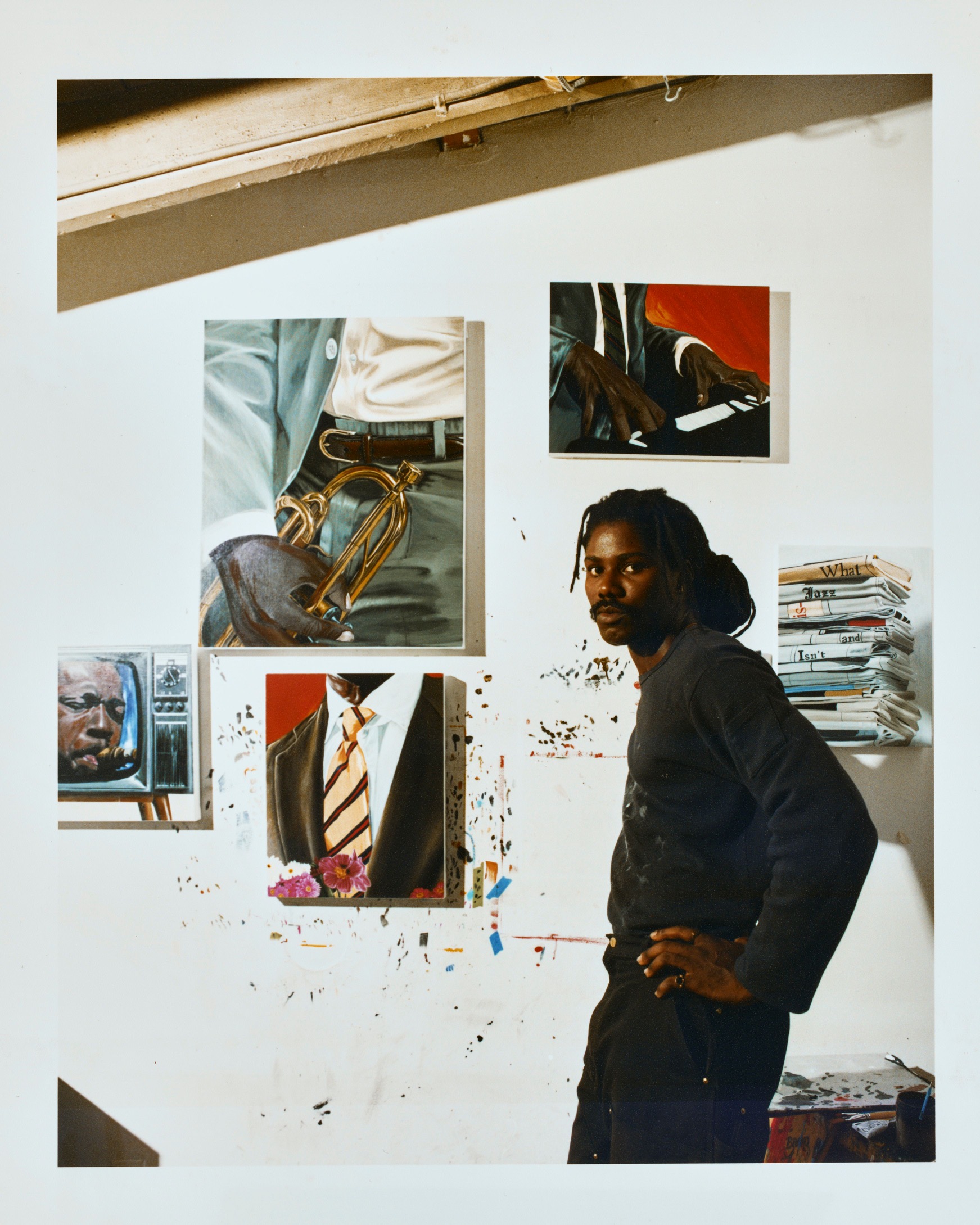
Born in Kansas City and now in Los Angeles, painter Jasaya Neale is not only a man with style, but a man of principle. His work conveys a truth and confidence in how we should view ourselves when just wearing "clothes". Like the fundamentals we live by, each detail conveys a feeling of pride and accomplishment. Without high-nose ostentation, Jasaya undresses the opinion that only a certain group of people should have the privilege of being allowed to wear or buy certain garments, but really, the people who worked hard to purchase them. Oddly, some of the poor work to look rich while the rich work to look poor or average. Rich man or working man, who can tell the difference when class, much like style, can't be bought.
Photo by Darren Vargas
Jasaya was kind enough to engage in a bit of Q & A with me:
Ian Randolph: Are you afraid to be an artist more popularized by your looks than your work?
Jasaya Neale: Definitely because you'll see these fashion model dudes that kind of do art, but they get known for modeling more rather than being taken seriously as artists. That's for anything too. Like, you could be a musician and kind of stop doing music and start doing fashion or stuff like that. I think it's just so natural when a brand works with you and likes your work. I feel like I've been blessed enough to do my own thing. With modeling and with artwork, you can do stuff with the biggest brands. I can see how that kind of popularity can erase the work that you've made, but it's all still me. Because sometimes you can benefit from brands like they are from you. We make the shit look cooler, so at the end of the day, if you keep that mindset, it'll always stay. Manifest, work on the shit you like, and it'll work out.
IR: Like some of the art legends, such as Basquiat, Jackson Pollock, and Picasso, they all had great personal style. How would you describe yours?
JN: Personal style, man... that's a good question because it does come back to the artist and their style and who they are. It's as important as the work. Much like how you look and how you carry yourself. Your energy, you know. I'll speak the word before anything. I think my first start just goes back to skating. I grew up skateboarding and being in that culture. There was that freedom of wearing whatever the fuck you wanted to wear. I never really felt for trends, and people looked at me weirdly, just growing up as a black skater. I mean, this is every black skater's story, but my personal style came from that. There was such a group of people skating, and back then, you were influenced by the baggy stuff, Nike SBs, and stuff like that. That was just always what I used to wear, but then I started getting into film, cinema, and photography. The old vintage look and 60s style, really. Tailoring incorporated how I put all my stuff together. Now today, I feel like cinema and jazz are a big influence on my style. I'm a moody type, so I love jazz. (Laughs)
IR: It's funny because when I first saw you at Capri Club with your people. I was like, man, this really is the "Mr. and Mrs. Cool guy bar," in a genuine way.
JN: Man! Shout-outs to Capri! Capri has the best people compared to other bars in LA. To me, Capri is just a good spot to meet good and genuine creative types. Artsy and stylish. It's always been cool.
IR: I think it's because it's the closest thing to a niche European bar that has gathered these like-minded people. Speaking of, when I saw you at Capri that night, I was like "Dude...this guy looks like the man"(Laughs). But I noticed one thing that really stood out, the KC Royals Hat you were wearing...
So when my boy Steve was asking if you were from Texas, I thought that was sick because you wore it as a symbol of pride, but also humbling nobility.
JN: Yeah! I wear all these like nice clothes, but let's not forget, I'm still from Kansas City. This is what made me, right? That's exactly what it is, man. People who can come from these small towns and shit that move to New York or LA and start wearing Yankee hats like I'm this now. They forget where the hell they came from. Come on. That's not what it is. I'm very humbled by what I've done. There's so much more to do, but I know I've made it far in my career to realize where I've come from, and I don't want to forget that. I'm doing these campaigns, shoots, and galleries, but you've got to let people know where you're from. You know what I'm saying? You're not going to catch me with Dodgers on my head. I'm not from LA, but I love LA. I respect it. I'm grateful, but also with my style, it's more of a uniform, which is very important to me. I feel like having a uniform, you know, is not for clout, but separating yourself from other people, because it's great to stand out. I think having a solid uniform and the consistency of having one is very sick in my opinion.
IR: Who are some artists who have inspired your personal style?
JN: Crazy. I mean, as far as OG artists...Noah Davis is a really big inspiration as far as artwork. A lot of African American cinematic shots that he would paint, but as far as the people that I'm really inspired by are the homies here, man. Like, shout out to Devin Reynolds, Ozzy, and Mario.
IR: Do you know Michael McGregor?
JN: Yeah, Gregor. Shout out, McGregor. I wouldn't be where I am in the art industry if I didn't meet these dudes. I would get put in group shows years ago from them, just like knowing me and being like, "Tree, like, you want to get in this group show I got?" That opened up gallery opportunities by going to their group shows, where people would be like, "Who's this cat?" I've gotten solos just from going through Ozzy shows. He and some other homies were getting known off that as well. That's the importance of having a good community here, too. These artists that I like looked up and pushed me to get to where these cats are. The homies.
IR: Is there a big art scene in Kansas City?
JN: KC has a big art scene for us. School-wise, KCAI is one of the best art schools in the country. KC Arts, too. It's right next to the Nelson A. Museum, but as far as like how we do art in LA, I feel like you don't really have to go to art school out here to get a solo show. I didn't go to art school. Almost did, but then I would go to these things downtown called First Fridays. It's where you just kind of like set up a booth or table and sell things. A lot of people come out, and I would sell drawings. I was like 17 or 18, and the moment that I knew I didn't want to go to school for art was when a woman who couldn't speak English bought my drawings. I think she was Brazilian. Anyway, I was selling those drawings for $100 at the time, and she grabbed 4. Again, she didn't speak any English, but something moved her to buy it and that's when I knew I needed to do this shit. From there, I was doing work for commissions, taking requests from people, but more amateur stuff. I mean, over time, you move to different cities, you get exposed, you meet people, and you grow. Moving out here and obviously getting into those group shows by meeting people helped me learn more about the art world. These experiences alone helped me realize that I made the right choice.
IR: Do you think being a Black artist is limiting or has a negative connotation when defined as one?
JN: That's funny you said that. I was just talking to a friend about this the other day. To answer that, I never wanted to be in that. That category of Black art. African American artists who only worked with Black galleries, black fundraisers, and things like that. I think it's very cool, though. From where we came as Black people, to be able to have our own galleries. You know, it's a lot of wealthy black people that are supporting Black artists and putting them in museums, which is fire, but I never wanted to be limited. I never wanted to just have to work with Black this and Black that, so that's why I'm in different shows that are group or topic-based. I've done an Afro-Caribbean show just out of love and curiosity, besides being that. My pops was from Trinidad, and being Trinidadian as well as Cuban, I always felt something shared between those cultures. Being out here with a lot of Hispanics and my homies put on a lot of Hispanic shows, where they put their people on the map in art. That made me think that I don't see any Caribbean shows here in LA seen as high art. That's something I wanted to do for sure. I used to paint old Latino people here in LA, to now working with European brands, but the message remains. I just don't want to limit myself because that's not the whole world. In America at least, Black art always had a traumatic aspect to it. That's the shit that irks me. I don't have to make art with colorful depictions of slavery because I feel that's the only way rich white people are going to collect it out of guilt. Some love the sob story of the African Americans’ work, but what I'm saying is that it doesn't necessarily have to be the main thing you do as a Black artist. I will say, I have respect for those artists who have made a full career out of it, but I would never limit myself in that way. I always wanted to be seen as a fine artist who can work with any culture. I want to show in galleries in Japan because they really respect art, regardless of whether it's only Black art. It's only art, period.
IR: How has fashion and modeling redirected the way you paint?
JN: Not in a crazy impactful way, but I think just more as it influences in the same way as a person who's never traveled and then seen the world, and how it opens up your eyes to meet different people. Style and how everyone else influences you is the same way as listening to different music. Just that one song or artist can open you up to new genres. Talking to models and producers on set, seeing what they do for a living, compared to what I do for a living. It's a nice wake-up call that I take back with me when I get home, so I can see how I can put this in my work.
IR: There's a great use of hue coordination in your paintings that allows the colors to be the real luxury in your work. Are you a fan of Kerry James Marshall?
JN: Yeah, he's one of my favorites.
IR: Do you know that whole thing about him using over 50 different shades of black in his paintings?
JN: Yeah, that's the detail of look. I have a book upstairs called The Studio Artist's Life, which has a whole bio on all his shades of black. It's insane. I kind of changed the different saturations that I used in my work. I used to do a lot of dark. Well, I still kind of do dark and moody colors, but when I do more of the luxury or loose works, I try to do brighter colors. Like if I'm painting ties, socks, and t-shirts, I just try to incorporate how I would like to dress into the work, too. I kind of use those colors depending on the work that I'm in.
IR: Your art details a life of luxury. From cars to clothes, do you think that it is still relevant in life to strive for nowadays?
JN: Yeah, I think it's definitely coming. We've seen it the most in the last few years. These couple of years have been very important. It's been very preppy and dapper, and that's been coming out in these little groups that are in style nowadays. It's very important right now. Younger people are realizing that having a genuine style now can be profitable.
IR: You know what's ill? I just got back from a trip to Rhode Island. Newport, to be specific, was the epitome of generational wealth. I was just surrounded by 4th vacation homes, boats, and people fueled by brunch chardonnays without a care in the world. It was actually sick (laughs). You'd be lying if you didn't want that lifestyle.
JN: (Laughs) A lot of those cats out there on the East Coast really embrace the lavishness of old money. I know brands like Gant and Drake's Diary do the most pop-ups in Rhode Island. They have a huge fan base out there. I can see that, and that would be sick to experience that at one's point. (Laughs)
IR: What's the most valuable possession you own?
JN: Probably my rings, my ties, and my loafers. Most importantly, the rings, though. I incorporate them into a lot of my work, too. A lot of hands and gold, which has always been a very Caribbean-Trini thing. I've always been connected, just like luxury gold rings, and if I don't have them on, I feel naked. It's always been a part of me, you know? It's going back to tone. Black skin and gold. I feel like darker skin has always been more attracted to gold. My mom was a jewelry designer, so I literally grew up around it. She would set up in venues and sell her jewelry. Though I'm the only artist/painter in my family, I've always been around people who were creative.
IR: Did you ever help contribute to her designs or jewelry-making?
JN: For sure. All of us did. I have five brothers and three sisters. A big household where she would always have us help her take her trays out to the venue she was doing, or help get her pliers to make jewelry. She would make her rings all the time. So yeah, I've always had rings on. I was the only one who really wore rings among my siblings. I don't paint when my rings are on, but like as soon as I'm done, I get them back on and keep it moving.
IR: What's something Kansas City has given you that you always take with you anywhere you go?
JN: Man... That's a good question. Obviously, the hat is the one. I think of how we met. Kansas City is a very, very friendly Midwest city with cheap beers, barbecues, and sports. The key is friendly beers while bringing you a good time, but humanizing people has always been a really important thing that I've done since I lived out here. Naturally, meeting people and just being genuine or not putting on an act gets you something in the future. I mean, that could be over-said also, but that's the Midwest. You think about the Midwest, and if you were to meet someone else from KC, St.Louis, or Chicago, you instantly have a connection. I take that everywhere I go, and that's why I wear the KC hat. It's funny in relation to LA because you always get that thing about transplants, but in my experience, I've noticed there are certain cities where people come from where they’re the same living in LA. Maybe there's something in the water in the Midwest. I think it's just that working-class, boots-on-the-ground kind of attitude. We're working together, and all that other shit is extra. I'm just here to do my job, do my thing, and just keep it moving. Sometimes I think that I'm not supposed to be here, especially since where I grew up. I grew up in the ghetto hoods of Kansas City with five brothers, a single mom, and no dad. I never even met my Pops. In high school, I knew a lot of kids I grew up with who got killed, and when skateboarding came along, that was obviously an outlet that helped me stay out of trouble. Those experiences alone made me grateful for my life and understanding that you can still love a place even if you have to leave it for good. I always keep that with me.
IR: Should fashion be held in the same reverence artistically as art?
JN: 100%. Speaking of that, I don't design clothes, but when I was growing up, I would go to a tailor and get clothes cropped. I think getting into that when I was in high school and going to prom, it always made me more interested in suits. I wanted to tailor my suit back when my shit was mad baggy. That shit was in, and I wanted to figure out how to do it. I bought this vintage ‘60s Playboy suit from this vintage shop back in high school, and I learned how to sew through YouTube tutorials. I learned how to do it, tailored my prom suit, and everything. From that moment, I realized how hard, how much time, and how many measurements when trying it on. That was a lesson in patience. I think if I were to transition into that, which last year I did a pop-up where I did 10 hand-painted T-shirts. Some white T-shirts and black T-shirts with jazz album cover illustrations. I did it in the most natural way possible I could do it. That transition really showed me to respect the seamstresses, the tailors, and the people working in these industries. Yeah, eventually, who knows, man... Like if a brand hits me about it. For sure. I got fingers crossed.
IR: What is something you would like to leave behind?
JN: That's a good one....Something to leave behind. I never really thought about that...I think my rings, my art, and the things that influenced me. I don't want to necessarily be this deeply impactful or influential artist, but I do want to be the example of what you can be if you believe in yourself. Just work fucking hard and do what you want to do. If you want to be an artist, you just have to not work a 9-5, and if you have to, that's sick too, but just know that being an artist is a full-time job. That's the only way you're going to make it happen. I learned that working at a job where I can't go to the studio, or I'm left too tired to create after, is detrimental. In the end, I just want to inspire people to go for it, and if I have some kids... leave them behind with my rings. Get that insurance! (Laughs)
IR: Are there any brands that you would like to work with?
JN: Yeah. As an artist, Gucci, Louis Vuitton, and Prada are among the fashion brands. Who wouldn't?
IR: Have you modeled for LV before?
JN: I haven't.
IR: I'm surprised.
JN: Well, two years ago, I was on hold for Pharrell's Paris show, and my passport had expired. It sucks because when I got the gig on June 10th, they needed me to fly out on June 17th. Damn, bro... but that's how the modeling world is. You’ve got to be ready at any time for that shit, but it was a good lesson learned. Now, the brands I want to work with are naturally happening. Manifestation is a real thing. When I started working with Buck Mason, Drakes, and Gant, I saw their campaigns and started DMing them. Luckily, McGregor knew and worked with people from Drake's Diary, so he thought I'd be a great addition to their brand. Five months later, Drake’s DM’d me and wanted me to do an edit. I think very important to what you say yes to because that'll just end up coming to you naturally anyway. You won't even have to really try to approach these brands. That's what taking pride in yourself and your work will get you.